
Core Services
Specialist Services
Not sure where to start?
Our free home care assessment helps you understand exactly what care your loved one needs - at no cost and with no pressure.
- We come to you
- Takes 45–60 minutes
- Written care plan provided
- No obligation to proceed
Or call us: 07883 247965
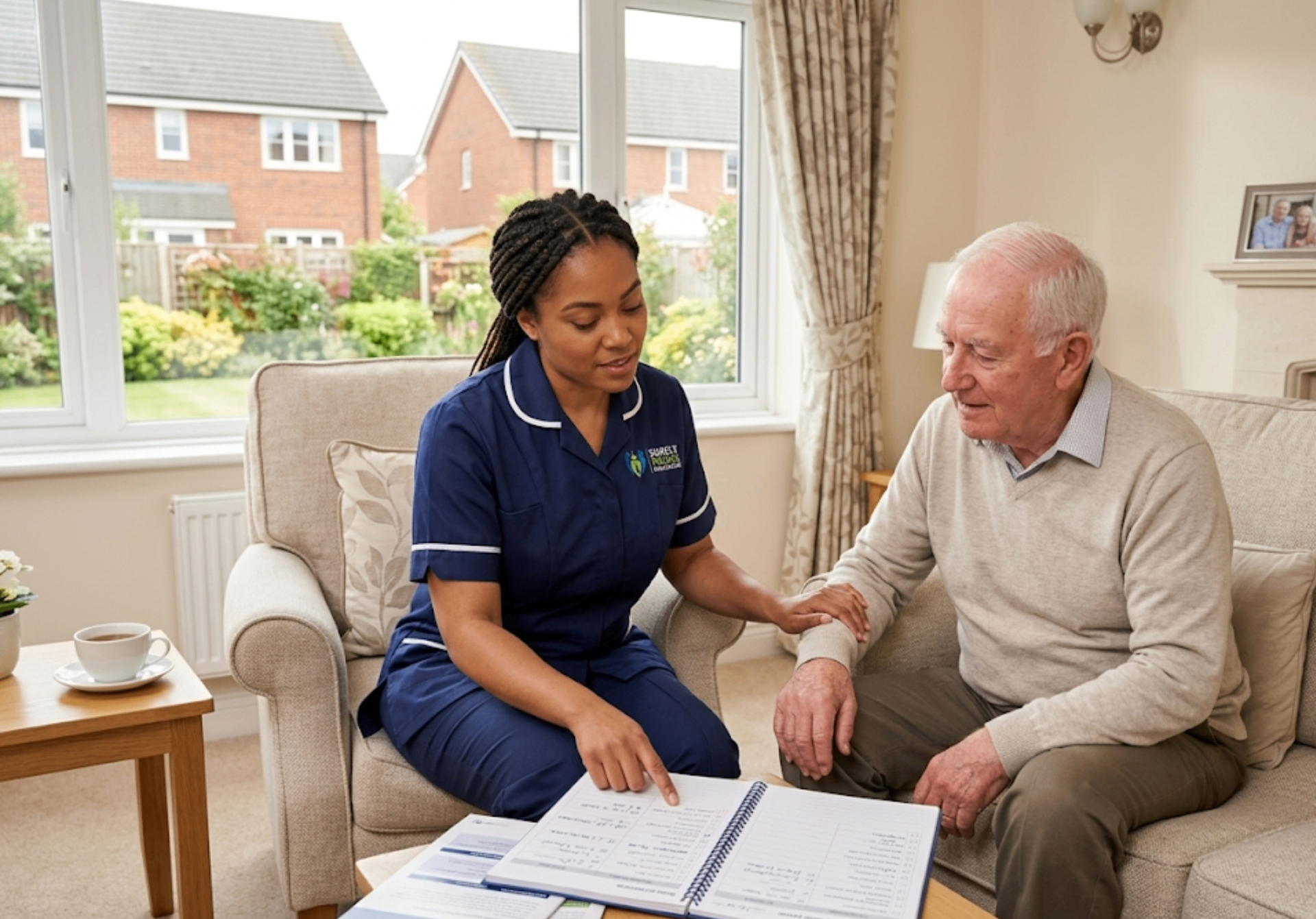
Condition-Led Care at Home
Living with a long-term health condition should not mean giving up the home, the independence and the life you love. Our condition-led care service delivers specialist, expertly informed support built entirely around your loved one’s specific diagnosis — enabling them to live safely, comfortably and with maximum independence at home across the UK.
What Is Condition-Led Care?
Standard personal care focuses on daily tasks — washing, dressing, meal preparation and companionship. Condition-led care goes further. It means that every aspect of your loved one’s care plan — the tasks, the techniques, the timing, the observations and the communication with clinical professionals — is specifically informed by the nature of their diagnosis.
A carer supporting someone living with Parkinson’s disease approaches care differently to a carer supporting someone recovering from a stroke. The tremor management techniques, the communication strategies, the medication timing and the fall prevention approach are all distinct. That specialist knowledge makes a meaningful difference to outcomes, safety and quality of life every single day.
At Surely Yours Healthcare, we train our carers to understand and respond to specific conditions — not just generic care needs.
📌 Condition-led care does not replace the clinical treatment provided by GPs, consultants and community nurses. It complements it — ensuring that the daily care your loved one receives actively supports the goals and recommendations of their clinical team.
Conditions We Specialise In
Our carers receive condition-specific training across a wide range of long-term health conditions. Below are the primary conditions we support at home across the UK.
Parkinson's Disease
Parkinson's Care at Home
Parkinson's disease presents unique care challenges - tremor, rigidity, balance difficulties, speech changes and the critical importance of on-time medication. Our Parkinson's-trained carers understand the progressive nature of the condition and adapt care accordingly.
Key focus areas: Medication timing and administration support · Fall prevention and safe mobility · Dysarthria communication strategies · Nutrition and swallowing support · Dignity-led personal care · Liaison with Parkinson's nurse specialists
Stroke Recovery
Post-Stroke Care at Home
Recovering from a stroke at home - with the right support in place - can significantly improve long-term outcomes. Our stroke-trained carers support physical rehabilitation, cognitive recovery and independence rebuilding, working in close coordination with physiotherapists, occupational therapists and speech and language therapists.
Key focus areas: Mobility and transfer support · Hemiplegia and one-sided weakness care · Communication support and aphasia awareness · Cognitive rehabilitation activities · Depression and emotional adjustment support · Coordination with rehabilitation therapy teams
Multiple Sclerosis (MS)
MS Care at Home
MS is a condition of variation - relapsing, remitting or progressive - and care must flex to meet the person wherever they are on any given day. Our MS-aware carers understand fatigue, spasticity, sensory symptoms and the emotional challenges of living with a fluctuating condition.
Key focus areas: Fatigue management and pacing · Spasticity and mobility support · Bladder and bowel care · Temperature regulation awareness · Emotional support through relapses · Coordination with MS specialist nurses
Diabetes
Diabetes Care at Home
For older adults living with Type 1 or Type 2 diabetes, daily care must account for blood glucose management, dietary needs, foot care and the recognition of hypoglycaemia. Our diabetes-aware carers provide informed, safe support that reduces risk and promotes stability.
Key focus areas: Meal planning and carbohydrate awareness · Foot and skin inspection · Hypoglycaemia recognition and response · Medication and insulin support · Monitoring and clinical reporting · Coordination with diabetic specialist nurses
Epilepsy
Epilepsy Care at Home
Living with epilepsy at home requires carers who are trained in seizure recognition, safe seizure management and clear, accurate post-ictal observation. Our epilepsy-trained carers provide safe, confident support that reduces risk and gives families genuine peace of mind.
Key focus areas: Seizure first aid and safe positioning · Post-ictal monitoring and recovery support · Trigger awareness and risk reduction · Accurate seizure diary recording · Medication adherence support · Emergency escalation protocols
Heart Failure & Cardiac Conditions
Cardiac Care at Home
For those living with heart failure, angina or other cardiac conditions, daily monitoring and symptom awareness are essential. Our cardiac-aware carers support safe activity levels, fluid management and early symptom reporting - helping to prevent hospital admissions and support stability at home.
Key focus areas: Fluid balance monitoring · Weight and oedema observation · Breathlessness management and activity pacing · Medication support and adherence · Dietary guidance and sodium awareness · Rapid escalation to clinical team when needed
COPD & Respiratory Conditions
Respiratory Care at Home
COPD, asthma and other respiratory conditions require carers who understand breathlessness management, inhaler technique support, activity pacing and early recognition of exacerbation. Our respiratory-aware carers provide calm, knowledgeable support that supports lung health and reduces crisis admissions.
Key focus areas: Inhaler and nebuliser support · Breathing technique and positioning · Activity pacing and energy conservation · Oxygen safety awareness · Exacerbation recognition and escalation · Liaison with respiratory nurse specialists
Acquired Brain Injury (ABI)
Brain Injury Care at Home
Acquired brain injury - whether from trauma, infection or other causes - can affect cognition, behaviour, communication and physical function in complex, individual ways. Our ABI-experienced carers provide structured, patient, person-centred support that respects the individual's unique presentation.
Key focus areas: Cognitive rehabilitation support · Behavioural awareness and de-escalation · Communication support and augmentative aids · Physical rehabilitation coordination · Family education and support · Neurological monitoring and reporting
How We Build Your Loved One’s Condition-Led Care Plan
No two people living with the same condition experience it in the same way. A care plan built around a diagnosis alone is not a condition-led care plan — it is a template. Ours are not templates.
Free Specialist Assessment
A senior member of our care team - experienced in condition-led care - meets with your loved one and family to understand the condition, its current presentation, the clinical team already involved and the day-to-day realities of living with it at home.
Condition-Specific Care Plan
We build a detailed, written care plan that addresses the specific requirements of the condition alongside your loved one's personal preferences, routines and goals. This document is shared with the family and updated regularly as the condition progresses.
Matched Carer Allocation
We carefully match your loved one with a carer who has specific training and, where possible, direct experience with their condition. Consistency of carer is essential in condition-led care - we allocate the same carer to every visit wherever possible.
Ongoing Review & Clinical Liaison
Condition-led care is not static. We review the care plan regularly - particularly following clinical appointments, hospital admissions or changes in the condition. Our carers communicate proactively with the wider clinical team at every stage.
Working Hand in Hand With Your Clinical Team
Condition-led care at home works best when the home care team and the clinical team operate as partners. Our carers are trained to communicate clearly and consistently with all professionals involved in your loved one’s care.
GPs and consultant specialists
We provide regular written updates and escalate clinical concerns promptly. We attend review appointments where appropriate and invited.
Community and district nurses
We coordinate visit schedules, wound care observations, catheter notes and medication records directly with community nursing teams.
Condition-specialist nurses
Parkinson's nurses, MS nurses, diabetic specialist nurses and stroke coordinators are key clinical partners. We welcome and respond to their guidance directly.
Physiotherapists and occupational therapists
We carry out home exercise programmes and mobility plans under physiotherapy direction and support OT-recommended equipment and adaptation recommendations.
Speech and language therapists (SALT)
We implement SALT-recommended communication strategies and safe swallowing guidelines with precision and consistency at every mealtime and interaction.
Our carers maintain clear written visit records after every call, which are made available to the clinical team on request and shared with families through regular updates.
Why Condition-Led Care Makes a Measurable Difference
The difference between generic home care and genuinely condition-informed care is not academic. It is visible — in outcomes, in hospital admission rates, in the confidence of the person being cared for and in the reassurance of their family.
Fewer Hospital Admissions
Carers who recognise early warning signs specific to a condition can escalate concerns before they become crises - reducing preventable hospital admissions
Better Medication Adherence
Condition-led carers understand why specific medications matter and support adherence more effectively than generalist carers who lack that clinical context
Slower Cognitive & Physical Decline
Condition-informed activity, stimulation and physical support actively supports the goals recommended by specialist clinical teams - with measurable impact
Greater Family Confidence
When a family knows their loved one's carer truly understands the condition - its risks, its patterns and its requirements - genuine peace of mind follows
What Families Say About Our Condition-Led Care
“My husband has Parkinson's and previous carers simply did not understand the condition. Surely Yours Healthcare was completely different from day one. His carer knows the medication timing matters, understands the tremors and communicates with his Parkinson's nurse regularly. It has made an enormous difference.”
— Linda F., wife of client, across the UK
“After my mother's stroke, we needed carers who truly understood what recovery looked like day to day. The team at Surely Yours Healthcare have been exceptional - patient, knowledgeable and always in communication with her physiotherapist. We could not ask for more.”
— Andrew C., son of client, Leigh-on-Sea
CQC Registered — Safe, Regulated, Accountable
Surely Yours Healthcare Ltd is registered with the Care Quality Commission (CQC) to provide personal care services across the UK, including condition-led and specialist care at home. Our Registered Manager is Mrs Theodora Machingura, who holds direct accountability for the safety and quality of every care package we deliver.
All carers providing condition-led care are enhanced DBS checked, condition-trained and regularly supervised.
Areas We Cover for Condition-Led Care
We provide specialist condition-led care across across the UK and the surrounding across the UK communities. Our local care team means your loved one benefits from carers who know the area and can respond promptly when circumstances change.
Condition-Led Care — Frequently Asked Questions
Request a Free Condition-Led Care Assessment
Complete the form below and a specialist member of our care team will be in touch within 2 business hours to discuss your loved one’s condition and how we can help. Alternatively, call us directly on 07883 247965.
Expert Care Built Around Your Loved One’s Condition
If your loved one is living with a long-term health condition and you want to know whether specialist condition-led care at home could make a difference, please get in touch. Our team is here to listen, advise and help — with no pressure and no obligation.